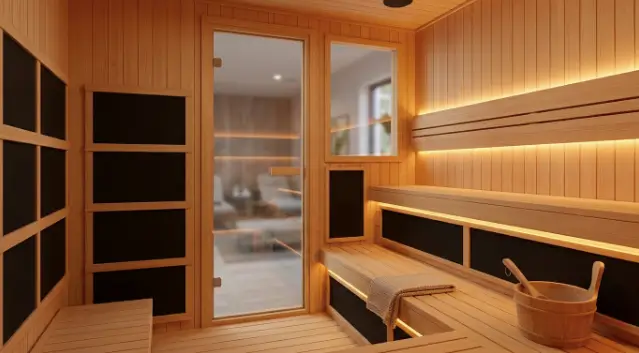
An infrared sauna maintained on a simple weekly routine, wipe-downs after each session, a deeper clean every one to two weeks, and an annual check of panel output and electrical connections, will typically run well past its 8 to 10-year panel lifespan without a major repair. Most failures that shorten a cabin’s life trace back to trapped moisture in the wood or a panel connection left loose after assembly, both of which are easy to prevent with a few minutes of attention.
What Should You Do After Every Session?
Sweat left sitting on wood benches is the single biggest driver of long-term wear in an infrared cabin. Wipe down the benches, backrest, and floor with a soft, dry or lightly damp cloth immediately after each session, before the cabin cools and the residue sets into the grain. Leave the door open for 15 to 20 minutes afterward so residual humidity escapes through the roof vent rather than sitting against the panels overnight, which is a small habit that meaningfully slows wood discoloration around the lower panel edges.
What Does a Deeper Weekly or Biweekly Clean Involve?
Once every one to two weeks, go over the interior with a cleaner labeled safe for sauna wood, or a light water-and-vinegar solution applied sparingly with a cloth rather than sprayed directly onto panel surfaces. Avoid standard furniture polish, oil soaps, or anything with solvents, since these can off-gas an odor once the cabin heats back up and, in some cases, leave a residue on the panel face that reduces infrared output slightly over time. Check the floor for any standing moisture near the panel bases, since infrared cabins sit low to the ground and a floor that does not fully dry between sessions is the most common source of warped baseboards.
How Do You Check Panel Output Over Time?
Carbon and ceramic infrared panels rarely fail suddenly; they lose output gradually, typically over 8 to 10 years or 5,000 to 10,000 hours of cumulative use. A simple annual check is timing how long the cabin takes to reach its normal operating temperature, usually 120 to 150 degrees Fahrenheit for far-infrared models. If warm-up time has stretched noticeably compared with when the cabin was new, one or more panels may be underperforming, which is worth confirming against the manufacturer’s stated wattage before assuming the whole unit needs replacing. Individual panels are usually replaceable without swapping the entire cabin.
What Electrical Checks Matter Over the Life of the Cabin?
Once a year, confirm the power cord and any wall-mounted control panel show no fraying, discoloration, or looseness at the connection points, particularly if the cabin sits in a garage or basement with more temperature swings than a conditioned room. A loose connection is a more common cause of an intermittently underheating panel than the panel itself failing, and it is a five-minute check compared with a panel replacement. If the cabin runs on a dedicated circuit, periodically confirm the breaker has not been showing signs of tripping under normal use, since a breaker nearing the end of its life will trip earlier and earlier before it fails outright.
How Should You Handle Long Gaps Between Uses?
A cabin left unused for more than a few weeks, over a vacation or a seasonal lull, benefits from a short warm-up cycle before the next real session, both to drive off any accumulated humidity in the wood and to confirm every panel is still heating correctly before someone sits down inside. Cabins stored in an unconditioned space over winter should be checked for any pest activity in the joints and for wood movement around the panel mounts, since wide humidity swings between a heated summer and cold winter room are one of the more common causes of hairline cracks in the interior paneling over several years.
See also: 5 Mistakes to Avoid When Booking Bus Tickets Online
What Should You Do If You Notice a Musty Smell?
A musty or damp odor developing in a cabin that did not have one when new is usually a sign of trapped moisture somewhere the daily wipe-down routine is not reaching, most often in the corners behind the lower panels or under the bench slats where airflow is weakest. Start by pulling the bench slats, if the design allows it, and checking underneath for standing moisture or early mold growth, particularly in a cabin installed in a basement or garage with higher ambient humidity than a conditioned living space. A mild vinegar-and-water wipe on any affected area, followed by running the cabin on a short warm-up cycle with the door open to fully dry the space, resolves most early cases before they become a larger problem.
If the smell persists after cleaning and a dry-out cycle, check the roof vent for any blockage and confirm the room itself has reasonable air circulation between sessions, since a cabin installed in a fully sealed closet with no airflow to the surrounding room struggles to fully dry out even with good post-session habits. A persistent musty smell that does not resolve with cleaning and improved airflow is worth treating as an early warning rather than something to mask with air fresheners, since it usually points to a moisture problem that will only get worse, and more expensive to fix, the longer it continues.
What Does the Research Say About Long-Term Sauna Use?
The case for maintaining a cabin well over many years is strengthened by what the longer-running research on sauna frequency shows. A 2018 review in Mayo Clinic Proceedings summarized cardiovascular associations tied to years of regular sauna bathing, generally strongest among people who kept up the habit consistently rather than sporadically. A 2023 follow-up review in the same journal examined how sauna use combines with other lifestyle habits over time. An older review in The American Journal of Medicine remains a useful reference on both benefits and contraindications across long-term use. These are association studies built mainly on traditional sauna cohorts, and a well-maintained infrared cabin used consistently for years is the scenario most in line with what the research actually measured, rather than occasional or short-term use.
For anyone comparing panel warranty terms before buying, since warranty length is a decent proxy for how long a manufacturer expects its own panels to hold output, current models and their listed warranties are visible at SweatDecks.
Frequently Asked Questions
How often should you clean an infrared sauna? Wipe down benches and walls after every session. Do a deeper clean of the floor and panel surfaces every one to two weeks to prevent sweat residue buildup.
How long do infrared sauna panels last? Typically 8 to 10 years or 5,000 to 10,000 hours of use. Panels usually decline gradually in output rather than failing outright.
Can you use regular wood cleaner on an infrared sauna interior? No. Standard polish or solvent-based cleaners can off-gas when heated. Use a cleaner labeled safe for sauna wood or a light water-and-vinegar solution.
What causes an infrared sauna to stop heating evenly? Usually one or more aging panels, a loose panel connection, or a control board issue, rarely the wood interior itself.
References
- Cardiovascular and Other Health Benefits of Sauna Bathing: A Review of the Evidence, Mayo Clinic Proceedings, 2018
- Does the Combination of Finnish Sauna Bathing and Other Lifestyle Factors Confer Additional Health Benefits? A Review of the Evidence, Mayo Clinic Proceedings, 2023
- Benefits and risks of sauna bathing, The American Journal of Medicine, 2001
By Peter Aldridge