
Good leadership starts with knowing yourself, respecting your team, and making decisions that align with clear strategic priorities. In practice, the traits that help leaders succeed in Melbourne or Sydney boardrooms often come from authentic, grounded approaches rather than flashy management theories.
At https://abmag.com.au, we’ve studied that the best business leaders let their teams grow and build cultures worth staying for. That’s why learning from those who’ve scaled companies here gives you practical insights you can follow tomorrow.
In this article, we’ll cover the core traits that define good leadership in Australian business contexts. We’ll also talk about the strategic priorities, risk management through change and uncertainty, and how to help employees grow so businesses can achieve long-term sustainability.
Read on to find out the strategies that help Australian businesses succeed.
What Makes Good Leadership? Core Traits That Set Aussie Entrepreneurs Apart
Good leadership boils down to two things: understanding yourself honestly and treating your team with genuine respect. It helps adjust communication skills and decision-making approaches.
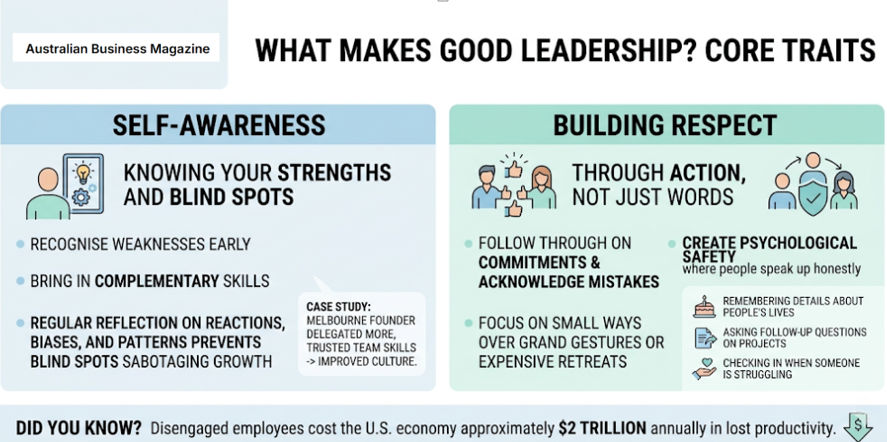
This is what good leadership means.
Self-Awareness: Knowing Your Strengths and Blind Spots
Self-aware leaders recognise their weaknesses early and bring in people who complement their gaps. Most leaders miss this completely when it comes to understanding how their team perceives them. But regular reflection on your reactions, biases, and patterns prevents blind spots from sabotaging growth.
For example, a Melbourne-based founder we worked with believed his expertise was important in every area.. Turns out, his team wanted him to delegate more and trust their technical skills. Once he understood that gap, the whole culture changed for the better.
Building Respect Through Action, Not Just Words
Respect grows when leaders follow through on commitments and acknowledge mistakes openly without deflection. In fact, showing genuine interest in team perspectives creates psychological safety where people speak up honestly. That’s how you build trust over time, not through grand gestures or company-wide emails about values.
It shows up in small ways, like:
- Remembering details about people’s lives
- Asking follow-up questions about their projects
- Checking in when someone’s struggling
These actions manifest more respect than expensive team-building retreats. On the other hand, leaders who overlook these behaviours risk weakening trust across their teams.
Did You Know? Disengaged employees cost the U.S. economy approximately $2 trillion annually in lost productivity alone (not a small price to pay for overlooking simple acts of respect).
See also: 5 Mistakes to Avoid When Booking Bus Tickets Online
Strategic Priorities: How the Best Leaders Focus Their Energy
Most SME leaders struggle with too many priorities, which ultimately means they have no real priorities at all. Meanwhile, strategic priorities help focus limited resources on what moves the business forward, not sideways. Based on our experience, Australian entrepreneurs who scale successfully typically identify three to five main goals at most.
This is how you can identify the right strategic focus:
- Match Opportunities to Core Strengths: If an opportunity looks shiny but doesn’t align with what you’re good at, it’s a distraction. At that time, focus on what builds your competitive edge.
- Learn to Say No: Every opportunity has a cost, but the best strategy comes from ruthless prioritisation. When you’re not trying to grab everything at once, you can make space for the great ones.
- Review Your Actions Quarterly: Most leaders find a huge gap between intention and reality when they finally measure where their energy goes. So track your time for a week and see if an opportunity reflects what’s most important to you.
The hardest part of strategy is choosing which ones to ignore. Especially when revenue looks tempting, or a partnership sounds exciting. However, picking fewer battles and winning them is much better than fighting on every front and losing momentum.
Making Hard Calls: Risk Management for SME Leaders
Learning risk management stops wasting your time and money on opportunities that were never going to work. Frankly, having this skill is the difference between successful entrepreneurs and reckless gamblers who confuse boldness with stupidity.

Follow these techniques to take calculated risks instead of blind optimism:
- Ask The Worst-Case Question: Ask yourself questions like, “What’s the worst realistic outcome, and can we survive that?” If the answer scares you or threatens the business, it’s probably not worth the risk, regardless of upside potential.
- Set Clear Exit Thresholds: It’s a good idea to decide upfront when you’ll pivot or abandon initiatives that aren’t working. This keeps emotions out of the decision when a project starts failing. Plus, it prevents the sunk cost fallacy from draining resources you could use elsewhere.
- Gather Multiple Perspectives: Team members and advisors often see blind spots you might miss. Their insights help you identify risks you didn’t consider and refine your strategy before moving forward. That’s how you can take more balanced decisions and reduce the likelihood of costly mistakes.
Sometimes the ability to walk away from a bad opportunity is just as valuable as spotting a good one. At the end of the day, every strategic decision comes with uncertainty, but great leaders know how to manage that uncertainty instead of ignoring it.
Growing Your People: Leadership Development in Real-World Settings
Leadership development in smaller businesses looks different from corporate programs. In a modest setting, your team’s growth directly limits or expands your business. Which is why the best Australian entrepreneurs build teams that eventually outgrow themselves in specific areas.
Here’s how you can direct your people toward progress.
Creating a Culture Where Talent Wants to Stay
Offering autonomy on projects shows trust and develops decision-making skills better than micromanaging. When you give employees the ability to make meaningful choices, they learn what works through experience, not theory.
Furthermore, creating clear growth paths even in small teams helps people see a future worth staying for. It doesn’t require fancy career ladders or corporate development programs. You can simply show people how their current role connects to greater responsibilities down the track. That clarity alone increases the retention of your team.
It’s also a good practice to recognise contributions publicly, which makes people feel valued beyond just their paycheck. We know it sounds tedious, but it pays off when you’re building a culture of collaboration. Plus, when people feel seen for their efforts, they bring more energy and care to everything they do.
Giving Your Team Room to Lead Themselves
Believe it or not,letting people make mistakes within safe boundaries teaches better than always stepping in to fix things. To give you an idea, when someone comes to you with a problem, try asking “what would you do here” instead of answering immediately. This develops independent thinking and problem-solving ability over time.
It might feel slower than just telling them what to do at first. But eventually, your team starts handling challenges without needing your input on every decision.
As a result, you get time back to focus on strategy and growth instead of being stuck in every operational detail. And that’s the real benefit of developing your people properly.
Start Leading Differently Tomorrow
Good leadership is mostly about self-awareness, respect, focus, and growing the people around you. The Australian entrepreneurs who succeed understand their strengths, pick their battles wisely, and take calculated risks without letting fear paralyse them. They create cultures where talent wants to stay because they give people room to lead.
So start with one area from this article and commit to it for the next month. Maybe it’s improving self-awareness, narrowing your strategic priorities, or delegating meaningful decisions to your team.
If you’re looking for more insights on building and scaling your career, head over to Australian Business Magazine for strategies on topics like cash flow management and hiring your first employee. Your leadership journey and success start with the next decision you make.